Saturday, 8 February 2020

Paper Prestonpans

I'm a big fan of the Helion Paperboys series of paper soldier books, along with their creator, artist Peter Dennis.  The paper soldiers, buildings and ships are fun and easy to assemble and they look great.  And, finally, last night I even managed to get in a game using them!


I took the forces I'd assembled from the Jacobite '45 book, and a scenario based on the Battle of Prestonpans.  All the paper models used were from this book, including the buildings and the trees, with the exception of the running redcoats, which I downloaded from Helion's website (although I just checked the link, and I was not able to access the Jacobite extras, although other files on that page are still available).  


As you can see, I experimented with different levels of detail with these models.  For some, I took some shortcuts, just folding and gluing the sheets, without cutting out all the detail.  These are still serviceable, but don't look as nice as when the full model is properly cut out.


The houses look just fine, they could likely fit on a game table with metal or plastic figures.


Kevin and Colin joined to take on the roles of Sir John Cope and Lord George Murray.  The rules used were Rebels and Patriots, from Osprey's Lion Rampant series of games, by Dan Mersey and Michael Leck.  Doug joined at the start, with a mini-tactical game where each general was asked to choose from a selection of deployment options.  By cross-referencing the selections, the initial deployment was determined.

Kevin, Colin and I have each played several of the Lion Rampant games, including Lion Rampant, Dragon Rampant, The Men Who Would Be Kings and Pikeman's Lament as well as Rebels and Patriots (RaP).  Each game represents an evolution of the game, with some differences being subtle.  We did our best to keep with the RaP version, although we quite deliberately disregarded the role of the officer (even though each army had a suitable chap on a horse to represent the army leadership).  I initially rated the highlanders as 'aggressive natives' and the Government troops as 'green' line, light cav and artillery.

Using Doug's deployment rules, the two armies started out deployed in neat lines facing each other.


The Jacobite strategy was to charge into contact, and the Government forces tried to shoot them down before they made contact.  The idea was that the green Government troops would be hard pressed to lay down enough fire to suppress the charging Jacobites.  The way things turned out was a bit different.


The Jacobite deployment, after taking some fire from the Government forces.  Paper figures don't look quite so fancy from the side!

Government forces rolled quite well for activation.  They quickly formed close order so that they could pour fire on the approaching Jacobites.


Jacobites, on the other hand, were plagued by rolls like this for their activation, leaving them under Government fire for extended periods of fire.


Eventually some of the depleted Jacobites made contact with the Government line.
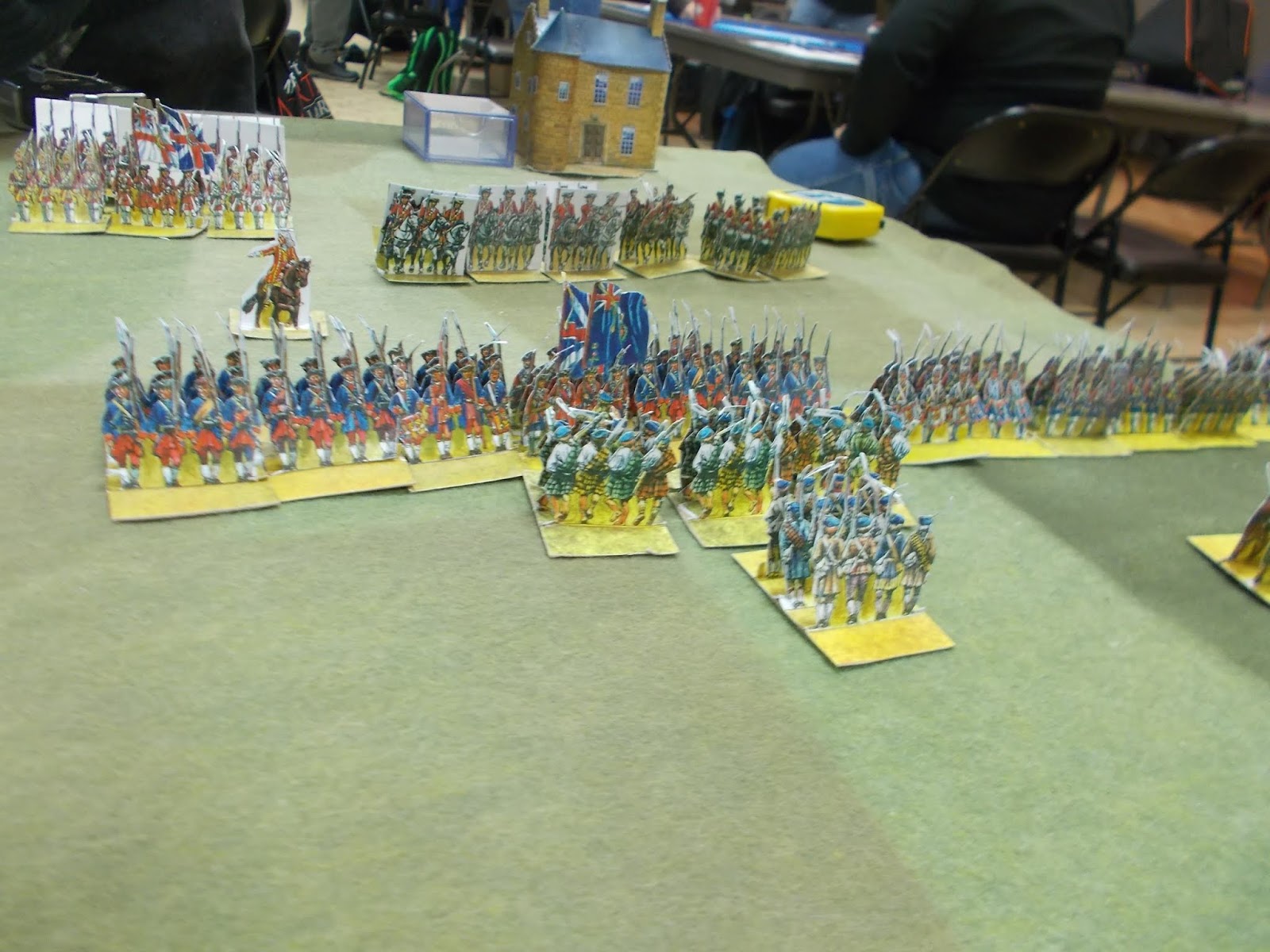

Even in their reduced state, the Jacobites were able to put a pounding on the Government line, but it turned out to be too little, too late.

As the first game went quickly, we did a quick assessment, and tried again!  Jacobites were given +1 discipline to reflect their enthusiasm to get stuck in, and the Government troops, being poorly trained, were not allowed to form close order. Kevin and Colin changed sides.  This time, Doug's deployment resulted in the Government forces lined up facing west to the expected arrival of the Jacobite army, while the Jacobites (as in the real battle) managed to sneak around Johnnie Cope's flank to launch their attack.


The Jacobites advanced through the marshy ground, while the Cope's army hurried to redeploy.


This time, Cope's Government forces were overwhelmed by the Jacobites.  The cannon, which was so devastating in the first game, barely got off a shot before being overrun.  


A couple of thoughts on Rebels and Patriots:  each iteration of the Lion Rampant engine develops the system a bit further.  I'm quite pleased with the way RaP works, keeps things simple and moving quickly.  It avoids some of the fussiness of TMWWBK.  I like that commands are likely to be followed early in the battle (even though a bit of confusion would have been historically accurate for Cope's green army!), but then things get harder as the battle progresses and units start to get worn down.

Um Bum Part 2 - Russian Village

Following on my previous post on Um Bum, here is part 2:  the rest of the 1/87 Russian country houses.   

The village now has four buildings and a few small outbuildings.  For gaming purposes, that's probably enough to have a small village where the heroes of the Soviet Union can resist the evil depredations of the Hitlerites.  

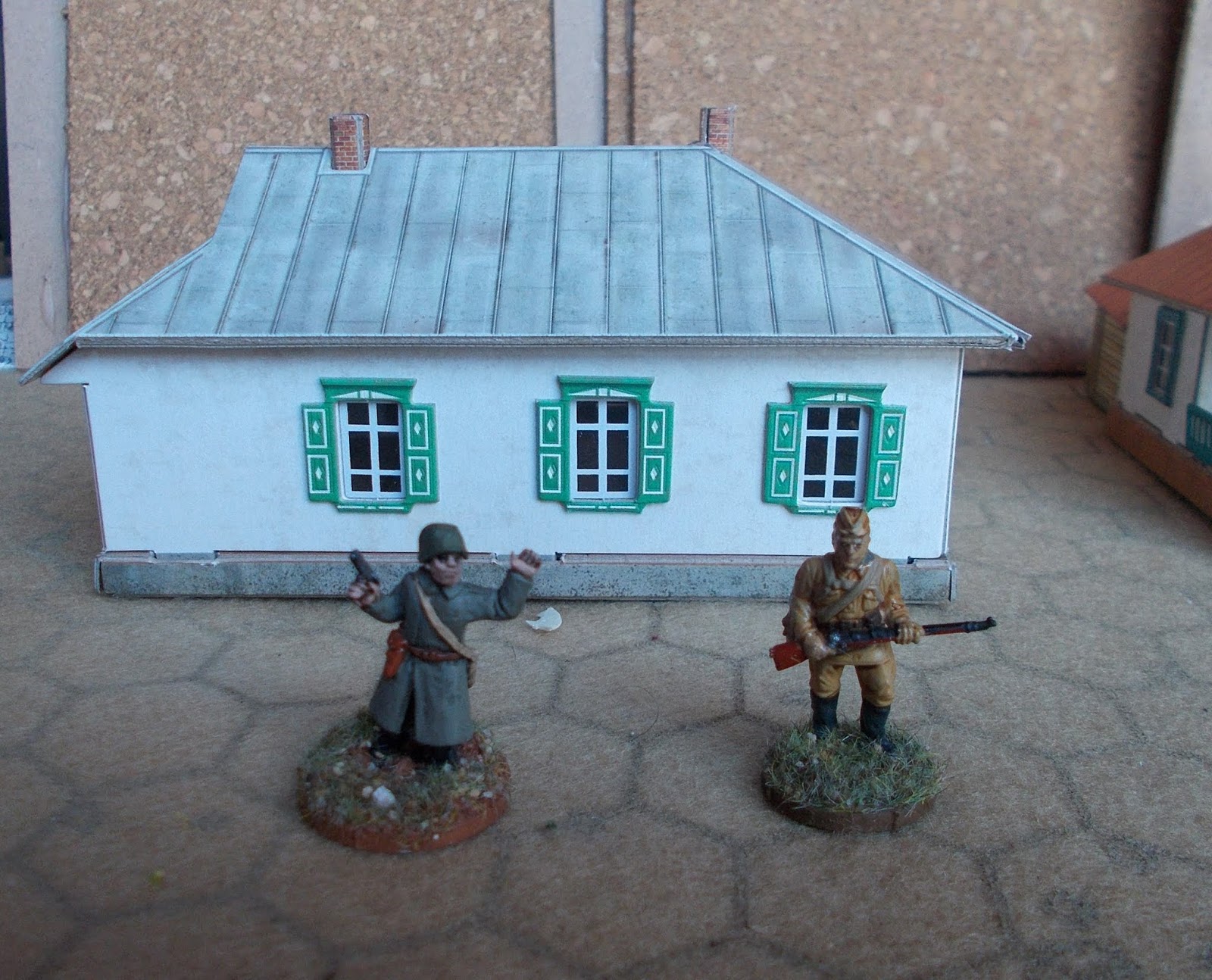
These HO scale buildings are a little small compared to the figures.  This would be a problem for a diorama, but for gaming purposes that's not really a problem.  Figures won't be placed inside the buildings, but the buildings clearly show the footprint of each building.
  

Although the buildings have some great internal detail, this will be hidden most of the time.  It's a bit fiddly to remove the roof, not something I'd want to do in the middle of a game.  But it's nice to know that it's there.


Even if it's only visible by peeking in through the windows!


Here are some closeup photos of the houses.


And here's the street scene.  


Figures (added for illustrative purposes) are from Copplestone Castings, Plastic Soldier Company and Bad Squiddo.

Sunday, 2 February 2020

PIAT

For my Operation Husky 1st Canadian Division project, I am using Perry Miniatures for both sides, especially the very versatile plastic Desert Rats box to build the bulk of the Canadian infantry.  However, as the Perry figures are primarily focussed on the campaigns in North Africa, they do not currently include a PIAT, as it was only introduced in time for Operation Husky in Sicily.  (I have heard that Michael Perry plans to make a PIAT soon, but naturally, I am too impatient to wait!)

So instead, I obtained some PIATs from Company B to re-arm the Desert Rats Boys Rifle gunner, and provided his loader with a suitable PIAT bomb, and here is the result.


Um Bum Part 1 - Russian House

On my recent trip to Russia, I picked up several cardboard models produced by Um Bum.  Check out their website - they've got a great selection of detailed cardboard models.  All the models in this photo combined came to 2000 rubles, which is less than CDN$50.


The models are detailed inside and out, and can be built very quickly with no glue, no scissors or any other tools - except the toothpick (included in the kit) to poke out small pieces.  All cuts are perforated, so the pieces simply pop out.

The first model I built was the Country House No. 3 (СЕЛЬСКИЙ ДОМ №3 in Russian).  This is a fairly typical rural Russian house, which could be found from the 19th Century onward.  Sheets are printed on both sides in full colour on heavy card, just need to pop them out and assemble following the very clear instructions on the very clear and easy-to-follow instruction sheet!  Windows are provided, with adhesive in place, just peel off the backing and stick in place.


As you can see, the interior is just as colourfully detailed as the exterior.


Here is the finished product.


The model is 1/87 (HO scale) which makes it a bit undersized for my 28mm figures,  This is demonstrated in the following photos.  On the other hand, it's ok to have buildings a little undersized compared to figures for most games, so these are probably fine to use as is for my WWII gaming!  Reference figures are from Crusader Miniatures and Plastic Soldier Company.


T-26

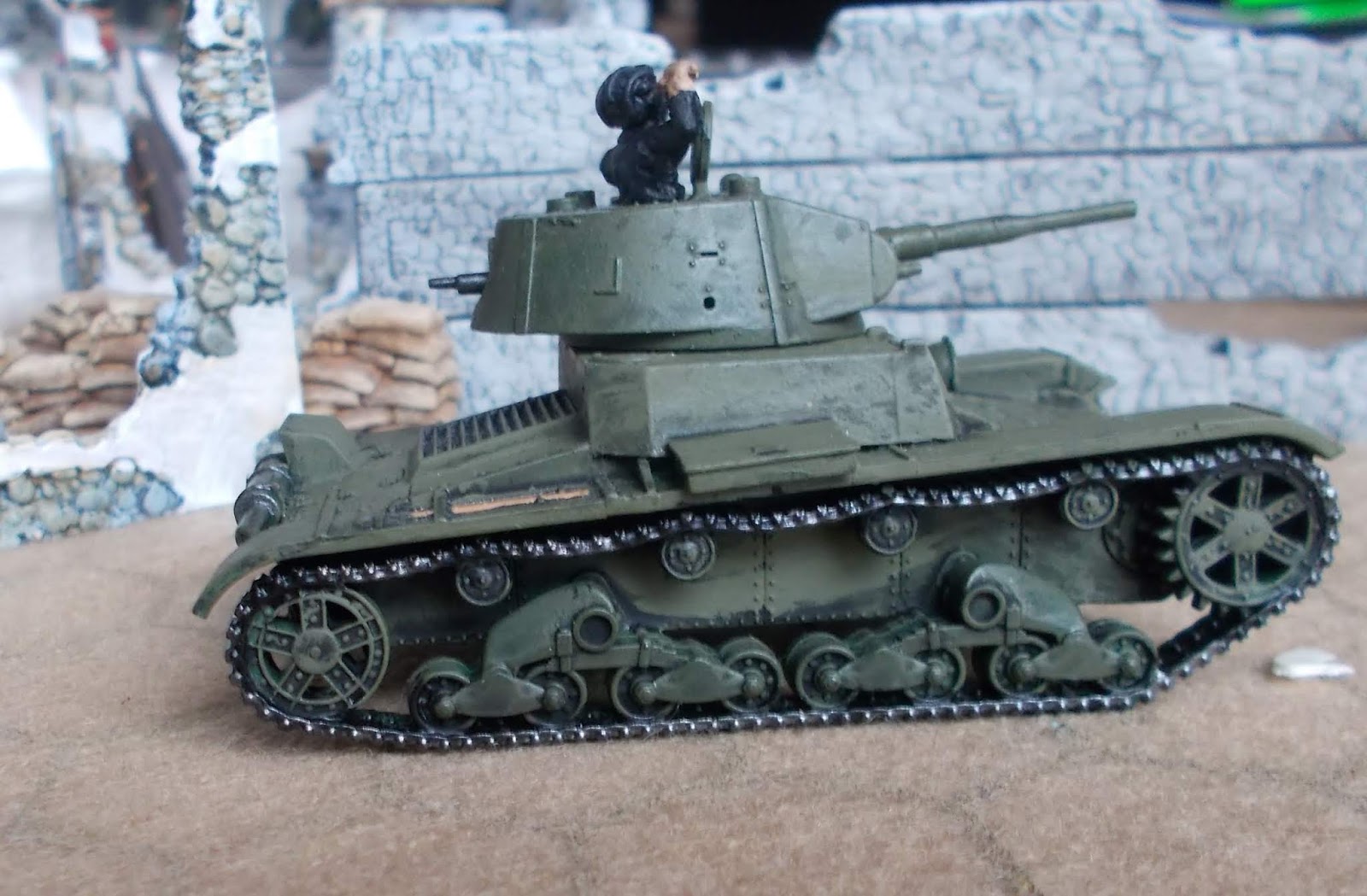
Here's the latest addition to my Red Army for Operation Barbarossa.  The T-26 was arguably the most effective tank in the Spanish Civil War, but by summer of 1941, it had been superceded by more recent designs with more powerful guns and heavier armour.  However, it still can be quite useful - especially when my side has a tank (even if an older model) and my opponent does not!  And the Red Army certainly had plenty of them in 1941 - over 10,000 of them at the start of Operation Barbarossa.  

This particular is from Rubicon Models.  It's a pretty amazing kit, as it contains enough stuff in it to build any of 10 different variants, ranging from the original models used in the SCW, through flamethrower and command variants, to versions with two turrets.  As my focus is on Operation Barbarossa, I chose the M39 version with a 45 mm gun in the turret.  


The commander is removable, to show whether the tank is 'buttoned' or 'unbuttoned'.  I didn't allow for the hatch itself to be closed, so it will be assumed closed as long as the TC is not present!  TC is from Die Waffenkammer.  


In What A Tanker games, we've learnt not to underestimate these older, smaller tanks.  Even though they aren't packing the heaviest guns or armour, they still have enough power to take out (or at least hurt) the other tanks on the table.  It can be a nasty surprise for one's opponent, after focusing all his attention on the T-34 or the KV-1, to be knocked out by the little T-26!

Monday, 27 January 2020

Reinforcements for the Germans

As I mentioned in my previous post about assembling a Fallschirmjäger Zug for Operation Husky, the Zug was noticeably under its paper strength.  It was short about a dozen men including 3 MG teams.  

So first step was another postal order to Perry Miniatures!  That got me another three FJ machine gun teams, this time equipped with MG-34, mostly just for variety compared to the MG-42 that their comrades carry.  I am concerned a bit that the MG barrels are a bit thin and thus liable to snap, so I will be careful handling these figures.


As before, each team has their squad marked on their base to avoid confusion.

Perry Miniatures also supplied a LG40 recoilless gun, to add a bit of firepower in case these fallschirmjäger end up facing any allied armour.


The LG40 had a considerable backblast, so using in a confined space was not recommended!  The set also includes a nice little hand cart.


The Zug was still under-strength by about 6 men, and according to my Chain of Command lists, the LG40 and the tripod-mounted MMG teams were also short one crew member each.  I decided to make up the numbers with recruits from the Perry Miniatures Deutches Afrika Korps set.  While these recruits are not wearing the distinctive FJ jump smocks, I figured there might be a few possible reasons:  they may have removed (or lost or destroyed) their smocks, or they may have been transferred over from other units.  More glaring are the ones with standard German infantry helmets rather than the FJ jump helmets.  I tried to mix up the uniform colours and provide a mix of helmets and field caps to show troops who have been in the field for some time.  Again, bases are marked to show to which section each soldier has been assigned.


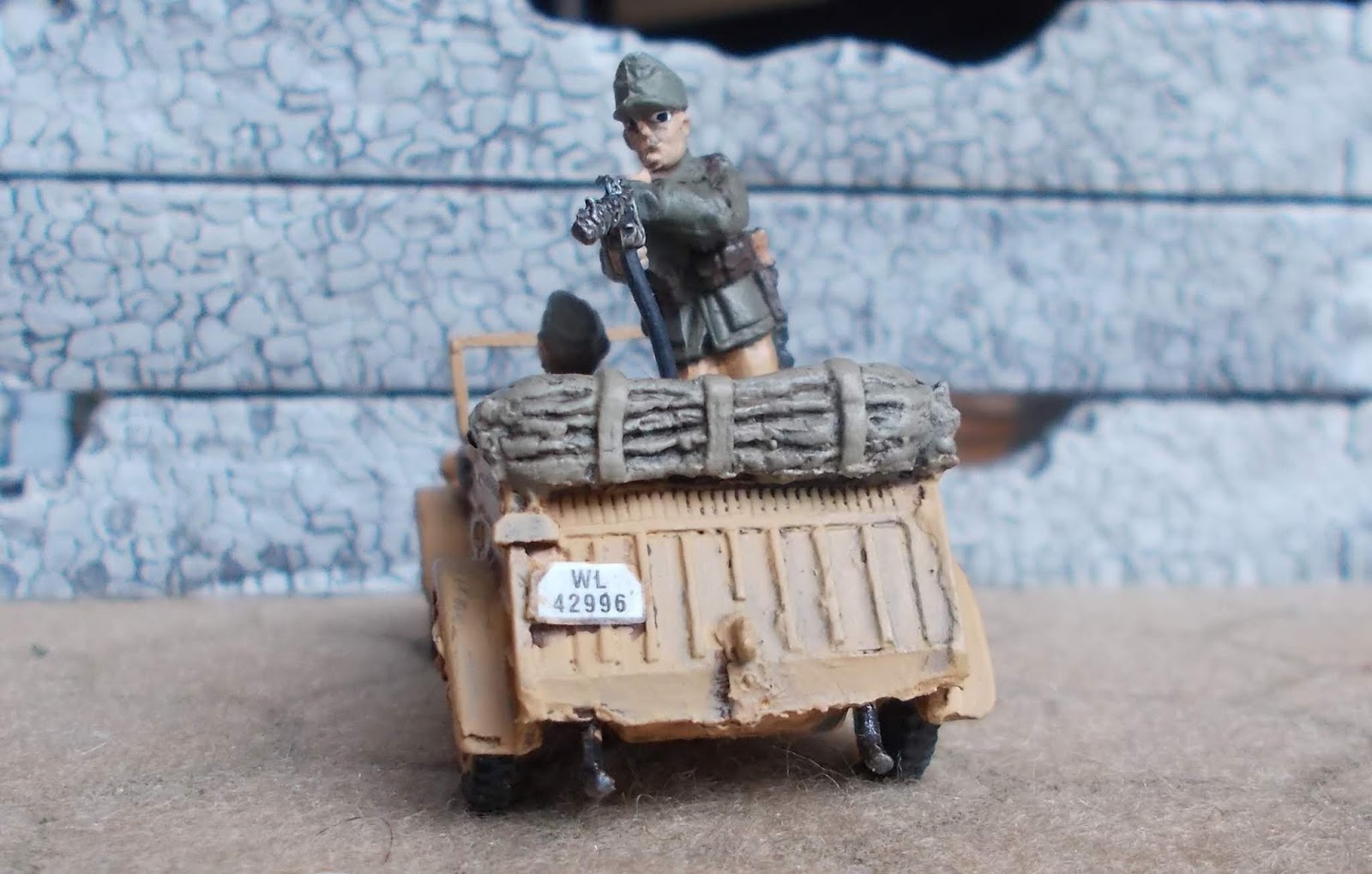
One more addition to the German force is this Company B kubelwagon, complete with a driver and machinegunner.   This will give the FJ Zug a recce option which may or may not come in handy.  The decals are leftovers from the sheet that came with the Rubicon Opel Blitz.